Archducal crown
The KillerThe Archducal crown is a piece of royal regalia that makes authority visible in ceremony and onstage. Its changing treatment marks a sharp progression: it is blessed and placed on Duncan, separated from him as he is overthrown, displayed in Macbett’s triumph, and finally thrown aside by the crowned woman as she sheds her ceremonial identity.
Regalia and investiture
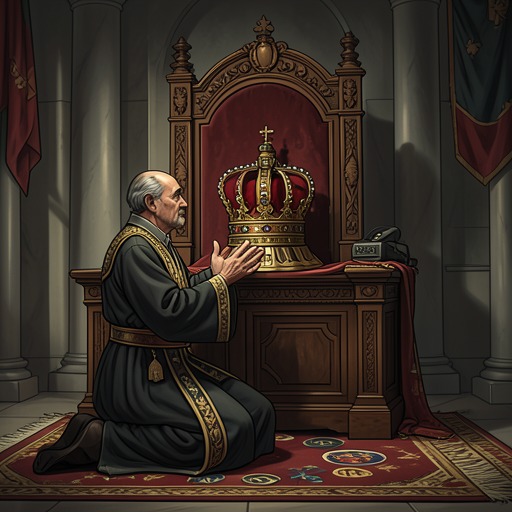
The crown first appears among the objects carried by the Officer: Duncan’s purple robe, the crown, and the royal scepter. The Monk takes the crown, blesses it, and approaches Duncan, who kneels. Placing it on his head, the Monk declares, “In the name of Almighty God, I confirm you in your sovereign power.” Duncan answers, “May the lord make me worthy.” The rite presents the crown not as authority by itself but as an object through which religious ceremony confirms a ruler’s claim. Its transfer from the Officer to the Monk and then to the kneeling Duncan turns the regalia into the visible center of an act of investiture.
The crown in the overthrow
That ceremonial order is violently undone when Duncan retreats toward the throne and those around him close in. As he tries to ascend the steps, the crowned woman tears away his cloak; Macbett pulls him down. In the struggle, Duncan’s scepter falls one way and his crown the other. The scattered regalia give physical form to the loss of the sovereign position that the Monk had just confirmed. The crown’s fall accompanies Duncan’s defeat, while its separation from the scepter makes the collapse of his authority visible in the stage action.
A new coronation and a changed meaning
Macbett and his crowned bride later appear in state robes, crowns, and purple robes, with Macbett carrying the scepter. Bells ring as they wave to the cheering crowd, whose acclamations hail the new rulers. The crown therefore returns within another public display of sovereignty: the regalia associated with Duncan’s investiture now frame Macbett’s accession and the crowd’s celebration. The ceremony’s visual language persists even as the ruler changes.
Rejection of the sacred emblem
After the ceremony, the crowned woman says that Macbett has gone to sleep and urges the waiting woman to hurry before the wedding feast. She then throws away the “sacred and anointed crown,” removes her cross, and changes into a witch’s costume. Her account of the cross burning her and the white dress burning her too links the discarded crown to a sacred identity she cannot sustain. The object that had solemnly confirmed Duncan’s sovereign power is now cast aside amid the exposure of a concealed identity. Across these appearances, the crown’s authority proves inseparable from performance: it can be blessed, worn, transferred in public spectacle, and rejected when the ceremony’s appearance gives way to what it concealed.